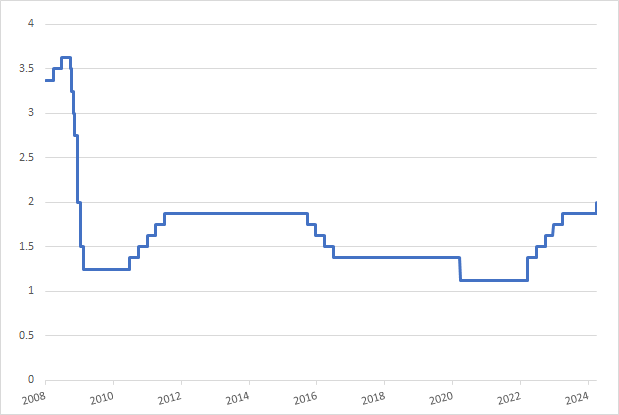
The discount rate is the interest rate that an eligible depository institution is charged to borrow funds, typically for a short period, directly from the Central Bank. The law requires that the interest rates of the Bank's discounts and other accommodations shall be determined by the Bank in the light of the financial and economic conditions, and made public.
For discount rate data, l ink to related Statistics
Q :
What are the systemically important payment systems in Taiwan?
A :
There are three systemically important payment systems in Taiwan. They are the CBC Interbank Funds Transfer System (CIFS), the Interbank Remittance System (IRS), and the Taiwan Clearing House System. The CIFS handles large-value payments and is a real-time gross settlement system. The IRS enables businesses and the public to perform direct remittance as well as government agencies and financial institutions to conduct treasury remittance and trade remittance. The Taiwan Clearing House System handles most ordinary payments, such as paper checks, and automated clearing house transactions.
Q :
What are the operational features of the CIFS?
A :
(1) Queuing Mechanism
The transfer of funds using CIFS is subject to the strict condition that the bank sending the transfer order holds adequate balances in its reserve account with the CBC. In the event of insufficient coverage, the transfer order is automatically held pending until covering funds have accumulated in the account through incoming payments and the pending payment can be settled automatically. The settlement of payments is determined by an order of priority which the sending bank can assign to a payment order. Within this order of priority, the FIFO («first in, first out») rule applies. Pending payments may be cancelled at any time while they are in the queue.
(2) Daylight overdraft facility.
(a) Eligible collaterals includes government bonds, treasury bills, NCDs or CDs issued by CBC.
(b) Before March 2003, no overdraft fees.
(c) After March 2003, rate charged for overdrafts = 1.75 % (annual rate).
(3) Set Throughput Guidelines - to smooth overall system flows
(a) For banks
At least 50% of value out by 2:30 p.m.
At least 80% of value out by 4:30 p.m.
(b) For bills finance companies
At least 30% of value out by 2:30 p.m.
At least 80% of value out by 4:30 p.m.
Q :
What are the daily volume and value of transactions handled by the CIFS, the IRS and the Taiwan Clearing House System?
A :
In the year 2001, the CIFS handled on average each business day 1,887 payments with a total value of more than $571 billion. The IRS handled a daily average of 256,450 payment items with a total value of more than $290 billion. The Taiwan Clearing House System handled a daily average of 694,367 payment items with a total value of more than $153 billion.
Q :
What is the legal basis for CBC oversight the payment systems?
A :
The newly revised Central Bank of the Republic of China Act has been approved by the Executive Yuan and is currently under scrutiny of the Legislative Yuan for approval. The legal basis for the Bank oversight the payment systems is contained in the item 4, Article 2 of the new Act, where it is established that one of the basic tasks of the Bank is “to ensure the smooth operation of the payment systems.
What are treasury bills and central government bonds?
A :
Treasury bills and central government bonds are marketable securities. The central government of the ROC sells in order to pay off maturing debt and raise the cash needed to run the central government. When you buy one of these securities, you are lending your money to the ROC government.
Q :
What distinguishes treasury bills from central government bonds?
A :
Treasury bills are short-term obligations issued with a term less than one year. Treasury bills are sold at a discount from face value and don’t pay interest before maturity. The interest is the difference between the purchase price of the bill and the face value amount that is paid to you at maturity.
Central government bonds are long-term obligations issued with a term more than one year. Central government bonds are issued with a stated rate of interest to be applied to the par amount, have interest payable annually, and are redeemed at their par amount at maturity.
Q :
What terms of securities do you offer?
A :
Treasury bills are usually issued with terms of 91 days, 182 days 273 days and 364 days. Central government bonds are issued with maturities of 2, 5, 10, 20, and 30 years bonds on regular basis.
Q :
Are central government securities still issued in paper form?
A :
No. All central government securities are no longer issued in physical form ( book-entry bonds since Sep. 1997 ; book-entry t-bills since Oct. 2001 ) .They are book-entry ( registered ) in computerized records, meaning they exist only as electronic records in computers.
Q :
Why should I buy treasury bills or central government bonds?
A :
Whether you should buy them is a determination for you to make. These factors may help you decide :
1. Central government securities are safe. They're
less risky than other investments since both principal and interest are guaranteed by the full faith and credit of the central government of the ROC. Besides, there is no risk of loss, stolen, or destroyed for book-entry securities.
2. Central government securities are liquid ; you can sell them at any time.
3. You can buy central government securities for a small amount of money – the minimum is NT$100,000.
4. Central government securities are exempted from securities transaction taxes.
5. You may trade central government bonds during when-issued period and hedge through diversified interest rate derivatives. ( For more information, contact a broker or dealer )
BUYING CENTRAL GOVERNMENT SECURITIES
Q :
How can I buy treasury bills and central government bonds?
A :
Central government securities may be bought on the following markets :
1. The primary market
Treasury bills are sold at auction, which is open to all banks, investment and trust company, insurance companies, bills finance companies, and the Chunghwa Post Co., Ltd. Individuals and other juristic institutions shall engage a bill broker to submit bids under the company’s name.
Central government bonds are also issued through sale by tenders, which are open to participation by designated Auction Group members only. Individuals and other juristic institutions may engage group members to submit bids under the member’s name. Purchase of NT$1 million or less may be undertaken through the Chunghwa Post Co., Ltd. and Taiwan Stock Exchange Co. ( TSEC ) .
2. The secondary market
If you want to buy t-bills, you may contact a bill dealer, such as banks or bills finance companies. To buy central government bonds, you may contact bond dealers such as banks, securities firms, and bills finance companies over-the-counter or quote via broker in the centralized market. For settling central government securities, investors need to open a security account and a fund account with clearing banks designated by the CBC.
Q :
How shall a foreign financial institution apply to be an auction direct
participant?
A :
The qualifications for membership of the Bond Issues Auction Group are as follows :
1. securities business approval from the authority ( insurance companies excluded )
2. net profit for the latest fiscal year
3. minimum NT$1billion of capital ; net worth per share
above face value
The approved members are obliged to submit both competitive and noncompetitive bids in every auction and to file annual financial report. In the event that any member does not meet certain financial condition criteria, a deposit of NT$ 10 million should be lodged.
Q :
How are central government securities issued in the primary market?
A :
1. Treasury bills auction is sold /buyback by
auction, which is performed electronically or through submission of written bid forms.
2. Central government bonds can be sold by
auction, placement, and commissioned sale. Sale by
auction is done electronically on-line.
Q :
What is meant by "competitive bidding"
and "noncompetitive bidding"?
A :
1. A competitive bidding is one where you specify the
prices or yields at which you wish to
purchase securities. In competitive bidding, bids will be accepted in order,
starting with those at the price higher
than the minimum acceptable price or the
yield lower than the maximum acceptable
yield set by the MOF. We adopted
single-yield method for treasury bill
auctions in Oct. 2001 and bond auctions
in July 2004 respectively. In a
single-yield auction, all successful
bidders are required to pay settlement
amounts for awarded securities at the
price equivalent to the highest accepted
yield.
2. By bidding non-competitively you
just specify the quantities you wish to
buy at the price or yield of accepted competitive
bid determined at the auction. In a
single-yield auction, all bids are
competitive, except 2% of the total
issue is allowed for small investors'
subscription through the Chunghwa Post
Co., Ltd. and Taiwan Stock Exchange
Corporation, subject to a maximum
subscription of NT$1 million each.
Balance of subscription is open for
competitive bids . The price for
subscribed bonds is calculated at the
highest accepted yield.
Q :
What are the basic rules for bidding?
A :
1. T-bills sale or buyback auctions :
Competitive bids must show the discount rate, with a minimum bid of NT$5 million each. Tenders above this minimum must be in multiples of NT$1 million. Current practice only allows competitive bids.
2. Central government bond auctions :
Competitive bids must show the yield bid, with a minimum bid of NT$100 million each. Tenders above this minimum must be in multiples of NT$10 million.
Q:
Can central government securities be pledged as collateral?
A :
Central government securities are legally permitted used as collateral for juridical provision. They also can be used as bank reserves required by the CBC, pledge of mortgage and guarantees in public undertakings.
Q:
Can central government securities be served as trust assets?
A :
Yes. Central government book-entry securities can be served as trust assets since July 2005. Holders of physical bonds are suggested to convert to book-entry bonds before applying for trust registration. Investor as a
trustor should conduct trust registration through clearing banks, and the ownership of the underlying securities will be transferred to the
trustee.
Q:
Are there quota limitations for foreign investors?
A :
1. Outright purchase/sell : There is no quota limitation for investing domestic government securities.
2. Repurchase ( repo ): The total amount of repos, time deposits and other monetary and future market instruments invested by FINIs and FIDIs shall not exceed 30% of its net inward remittance of investment funds.
GOVERNMENT SECURITIES SETTLEMENT SYSTEM
Q:
Who can participate in the Central Government Securities Settlement System(CGSS)?
A :
The CBC operates the Central Government Securities Settlement System ( CGSS ) connecting the CBC and the clearing banks. The CGSS is a real time gross settlement system (RTGS) for the issuance, transfer, redemption, and interest payment of the central government securities. Each clearing bank is obliged to maintain a security account and a fund account ( an account aside from reserve account, but serves as reserve balance ) with Department of the Treasury, CBC to participate in the CGSS . Both Department of Banking and Department of the Treasury of CBC also hold securities accounts for their own business.
Q:
What are the criteria for being a clearing bank?
A :
All banks ( including Taipei branch of a foreign bank ) that comply with the following requirements are eligible to submit application :
1. minimum NT$ 15 billion of net worth
2. minimum 8% capital adequacy ratio
3. minimum 6% average rate of return on net worth during the recent three fiscal years
Each clearing bank is required to enter into an agreement with the CBC. Should a clearing bank breach its commitment, the CBC reserves the right to suspend or terminate the appointment.
Q:
Can I convert physical central government bonds into book-entry bonds?
A :
Yes. The MOF announced the selected physical issues that were allowed for conversion in Jan. 1999. Since then, holders of the underlying issues of physical bonds may apply for conversion to book-entry bonds through clearing banks before maturity. However, it should be noted that book-entry bonds can not be converted back into physical bonds.
AUCTION INFORMATION
Q:
Where can I find up-to-date information on auctions?
A :
1. Both the CBC and MOF web sites post offering announcements and auctions results of t-bills and central government bonds.
2. The Electronic Bidding System participants can also obtain auction information through the EBS.
Q:
Where can I find long-range information on upcoming auctions—ones that are a couple of months or longer away?
A :
There are no auction schedules for t-bills. If the National Treasury fund is in adequate condition, the MOF may consult with the CBC to buyback some of the outstanding t-bills before maturity.
The MOF has started to disclose a regular issuance schedule for the central government bonds since 2003. However, the issue amounts and auction dates are set on a quarterly basis.
MISCELLANEOUS MATTERS
Q:
Who are the main participants of Taiwan bond market?
A :
The main participants are banks, bills finance companies, securities firms, insurance companies, mutual funds and institutions.
Q:
What are reopenings?
A :
Bond reopening mechanism was established in April 2003. In a reopening, we issue an additional amount of a previously issued bond. The reopened bond have the same maturity date and interest rate as the original bond ; however, compared to the original bond, the reopened bond has a different issue date and usually a different purchase price.
When buying a reopened bond, you must pay the interest the bond earned before you bought it ; However, the interest – It’s called “accrued interest” – has been reflected when bidding for reopened bonds, successful bidders should not ask the MOF to refund the taxes.
Q:
Who publishes daily information on how central government securities are performing on the secondary market?
A :
Daily yields and related information on the secondary bond market are available at the GreTai Securities Market ( Over the Counter ) .
Q:
What kinds of taxes shall I pay on investing government securities?
A:
I. According to the Income Tax Law :
1. Securities transaction tax is exempted.
2. Securities transaction income tax on capital gains is ceased to be imposed from Jan. 1990 ; at the same time, losses on bond transactions shall not be deductible from the amount of income.
3. Income tax :
( 1 ) t-bills :
( a ) OP/OS : 20% of the payment is withheld and taxed separately.
( b ) Repo : The agreed interest income from t-bills repo transaction shall be withheld and taxed as follows :
( b.1 ) A resident : After 10% withheld , interest income will be treated as a part of consolidated income and be taxed next year. ( with NT$ 270,000 interest income deduction at most )
( b.2 ) A domestic enterprise : After 10% withheld , interest income will be treated as a part of business income and be taxed next year.
( b.3 ) A nonresidents or an FINI not having its permanent establishment within the territory of the ROC : 20% withholding tax of its interest income.
( 2 ) government bonds :
( a ) OP/OS : Income from interest on bonds ( as above b.1~b.3 )
( b ) Repo : The agreed interest income from bonds repo transaction
( as above b.1~b.3 )
4. Futures transaction income taxes : suspended for the time being. ( losses on futures transactions shall not be deductible from the amount of income )
II. According to the Statute for Futures Transaction Tax :
5. Futures transaction taxes : In a futures transaction, both buyer and seller shall pay transaction tax as promulgated.
Whether the notes marked “Customs Gold Units?can be redeemed?
A :
The banknotes issued before 1949 in Mainland China were no longer valid as legal tender since the Monetary System
Reformation promulgated in August 20, 1948. The redemption period expired on November 20 in the same year.
Q :
Are the old-designed New Taiwan Dollar notes still valid?Whether the notes can be exchanged at any of the banks in Taiwan area?
A :
The old-designed New Taiwan Dollar notes issued from June 15, 1949 to June 30, 2000 and inscribed with the Bank of Taiwan, excluding commemorative polymer banknote, were not in circulation after June 30, 2002.
All the above-mentioned New Taiwan Dollar notes can still be redeemed at all branches of the Bank of Taiwan within Taiwan area.
Where can I find data on Taiwan's Real Effective Exchange Rate?
A :
Taipei Foreign Exchange Market Development Foundation’s website < http://www.tpefx.com.tw/htm/02ntd02.htm > contains the useful information on Taiwan's REER. Please note that the Foundation changed base period and currencies in 1996 without retrieval. You may contact the Foundation directly by their e-mail <tfemdfoo@ms79.hinet.net> for further information.
Q :
Where can I find data on Foreign exchange reserves of Taiwan?
What is the Central Bank of the Republic of China (on Taiwan)?
A :
The Central Bank of the Republic of China, often referred to as " the Central Bank ," is the central bank of the Republic of China on Taiwan . It formulates and executes monetary and foreign exchange policy, issues the nation’s currency, and serves as banker to the banks and the government.
Q :
When was the Central Bank of the Republic of China (on Taiwan) created?
A :
On February 21, 1923, Dr. Sun Yat-sen, National Father of the Republic of China, promoted the establishment of the Central Bank of the Republic of China with the primary goal of financing national developments in Canton. On November 1, 1928, the Central Bank formally commenced operations in Shanghai following the promulgation of the Statute of the Central Bank of Chin a, which was revised and became the Central Bank of the Republic of China Act on May 23, 1935.
Q :
What is the legal status of the Central Bank?
A :
According to the Central Bank of the Republic of China Act, the Central Bank is a state bank and an agency under the Executive Yuan (the Cabinet). The Central Bank has, however, continued to maintain its independence in the formulation and implementation of monetary policy.
Q :
How is the organization of the Board of Directors of the Central Bank?
A :
The Board of Directors, the highest policy-making unit of the Central Bank, consists of eleven to fifteen directors nominated by the Executive Yuan and appointed by the President. Five to seven directors of the Board of Directors are designated as executive directors. According to Article 5 of the Central Bank of the Republic of China Act, the Governor of the Central Bank, the Minister of Finance and the Minister of Economic Affairs are ex officio directors and executive directors. In addition, the Board of Directors also includes at least one member from each of the agricultural, the industrial and commercial, and banking sectors. Directors serve five-year terms and may be reappointed when their terms have expired. Currently, the Board of Directors consists of fourteen members, of which six are executive directors. The Board of Directors holds meeting four times per year.
However, the Central Bank is also pushing for the amendment of the Central Bank of the Republic of China Act. Once approved by the Legislative Yuan, all the members of the Board of Directors will serve on a full time basis and have their tenures staggered to further enhance professionalism and independence of the Central Bank.
Q :
Who are the clients of the Central Bank?
A :
According to Article 12 of the Central Bank of the Republic of China Act, unless otherwise specified by law, the Central Bank’s operations shall be circumscribed to business with government agencies, banks and other financial institutions, and international and foreign financial institutions.
Q :
How is the relationship among the Central Bank, the Ministry of Finance and the newly established Financial Supervision Commission?
A :
The Financial Supervision Commission (FSC) under the jurisdiction of the Executive Yuan, will commence its operation from July 1,2004. There will be a close co-operation among the Central Bank, the FSC and the Ministry of Finance (MOF) in the field of financial stability. The responsibilities of the above agencies set out in the relevant statutes are as follow:
The Central Bank’s responsibilities
The Central Bank is responsible for formulating and executing of monetary, credit and foreign exchange policies as to promote the overall stability of the financial system which involve to guide sound banking operations, to maintain the stability of the internal and external value of the currency, and, within the scope of the above, to foster economic development.
The FSC’s responsibilities
The FSC is responsible for the development in financial supervision regulations, and undertaking the examination of financial services and markets.
The MOF’s responsibilities
The MOF is responsible for the formulation and enforce ment of nation al fiscal policy, particularly,customs affairs, taxation and nation al properties.
Through the exercise of each statutory responsibilities, the Central Bank, MOF and FSC will set out the mechanism on the exchanging of information, consultation on policy making or changing which will ensure the three agencies work together towards the common objective of financial stability.
:::updated:2007/2/12
Best viewed with IE 5.0 or higher with 800×600 resolution/Privacy/Security/FAQ
Copyright @2004 the Central Bank of the Republic of China Add./
Map
: 2, Sec. 1, Roosevelt Rd., Taipei, 10066, Taiwan, R.O.C. / Office Hours
Tel: 886-2-2393-6161 Fax: 886-2-2357-1971