Welcome to the Central Bank of the Republic of China(Taiwan)
CBC logo
:::Leftmenu
advanced search
about the bank
Monetary Management
Foreign Exchange Management
Financial Stability and Bank Supervision
Payments Systems
Currency Issuance
Press Release
Speeches
Publications
Statistics
Laws and Regulations
Definitions of key financial terms

cbc_logo back image
:::
Chinese
site directory
link
contact us
home
Back
Laws and Regulations
:::Main Area
Position : Laws and Regulations >> The Central Bank of China Act

TheCentral Bank of China Act
Promulgated on May 23, 1935
As amended on November 8, 1979
Text of Articles 23 and 44 amended on May 21,1997
Article 23 amendment effected on July 7, 1999
Text of Articles 18-1, 18-2 and18-3 added, 32 and 35 amended on June 5, 2002

*
Chapter I. General Provisions

* Article 1:

The Central Bank of China (hereafter called the Bank) shall be a government bank and an agency under the Executive Yuan.

* Article 2:

The primary objectives of the Bank's operations shall be:1. To promote financial stability;2. To guide sound banking operations;3.To maintain the stability of the internal and external value of the currency;4.To foster economic development within the scope of the above objectives.

* Article 3:

The Bank shall have its Head Office at the site of the Central Government and may establish branch offices in all regions of the country. The establishment and abolishment of its branch offices shall be authorized by the resolution of the Board of Directors and reported to the Executive Yuan for approval.

* Article 4:

The capital of the Bank shall be appropriated from the National Treasury. It shall be fully owned by the Central Government and nontransferable.

*
Chapter II. Organizations

* Article 5:

The Bank shall have a Board of Directors consisting of eleven to fifteen directors to be nominated by the Executive Yuan and appointed by the President of the Republic. An Executive Board of Directors composed of five to seven executive directors shall be designated among the directors.

The Governor of the Bank, the Minister of Finance and the Minister of Economic Affairs shall be ex officio directors and executive directors. Among the directors, there shall be at least one each from the agricultural, the industrial and commercial, and the banking sectors.

Except for the ex officio directors, the directors shall be appointed for a term of five years, and may be reappointed upon the expiration of such term.

* Article 6:

The powers and functions of the Board of Directors shall be as follows:

1. To examine policies concerning money, credit and foreign exchange;

2. To examine the adjustment of the Bank's capital;

3. To approve the operation plans of the Bank;

4. To examine the budget and fiscal reports of the Bank;

5. To examine and approve major by-laws and regulations of the Bank;

6. To examine the establishment and abolition of the Bank's branch offices;

7. To approve the appointment and the removal of the Bank's department heads and their deputies, and branch managers;

8.To examine matters proposed by the Governor.

The Board of Directors may delegate all or part of the above powers and functions to the Board of Executive Directors. The resolution of the Board of Executive Directors shall be reported to the Board of Directors for record and approval. The Board of Directors shall establish rules and regulations of board meetings.

Such rules and regulations shall be reported to the Executive Yuan for record.

* Article 7:

The Bank shall have a Board of Supervisors, composed of five to seven supervisors to be nominated by the Executive Yuan and appointed by the President. The Director-General of Budget, Accounting and Statistics of the Executive Yuan shall be an ex officio supervisor.

Except for the ex officio supervisor, the supervisors shall be appointed for a term of three years and may be re-appointed upon the expirations of such term.

The Board of Supervisors shall have a chairman to be elected from among the supervisors.

* Article 8:

The powers and functions of the Board of Supervisors shall be as follows:

1.To examine the Bank's assets and liabilities;

2.To audit the Bank's accounts;

3.To examine the reserves for the issuance of currency by the Bank;

4.To examine the amount of currency issued by the Bank;

5.To examine and approve the Bank's fiscal reports;

6.To investigate any case involving violation of this Act and the by-laws and regulations of the Bank. The result of such investigation shall be referred to the Board of Directors for corrective action.

* Article 9:

The Bank shall have a Governor with the rank of special appointment and two Deputy governors with the rank of selective appointment, all of whom shall be appointed for a term of five years and may be reappointed upon the expiration of such term.

* Article 10:

The Governor shall be the chief executive in directing and supervising the operations of the Bank, shall carry out resolutions of the Board of Directors, and shall represent the Bank on all occasions. The Deputy Governors shall assist the Governor in the execution of the above duties.

The Governor shall be the chairman of the Board of Directors and the Board of Executive Directors. Whenever the Governor is unable to attend in person, the Deputy Governor designated to act for the Governor shall be the chairman.

* Article 11:

Upon the resolution of the Board of Directors and approval by the Executive Yuan, the Head Office of the Bank may establish the following departments to effect its operations:
1.Department of Banking.
2.Department of Issuing.
3.Department of Foreign Exchange.
4.Department of the Treasury.
5.Department of Financial Inspection.
6.Department of Economic Research.
7.Secretariat.
8.Department of Accounting.

The Head Office of the Bank may establish committees to handle special matters.

*
Chapter III. Operations

* Article 12:

Unless otherwise specified by law, the Bank's operations shall be circumscribed to business with the following organizations:

1.Government agencies.

2. Banks and other financial institutions.

3. International and foreign financial institutions.


* Article 13:

The currency of the Republic of China shall be issued by the Bank.

The currency issued by the Bank shall be the national currency, and shall be legal tender for all payments within the territory of the Republic of China.

The Bank shall establish plants under its management to carry out the printing and minting of the currency.


* Article 14:

The Bank may, whenever necessary, delegate other government banks to issue currency by region on its behalf, to be regarded as national currency.  The assets and liabilities pertaining to the issuance of such currency shall be for the account of the Bank.


* Article 15:

The basic monetary unit of the national currency is Yuan and the subsidiary currencies are Chiou and Fen. Ten Fens equal to one Chiou and ten Chious equal to one Yuan.

The denomination, ingredient, form, and pattern of the notes and coins issued by the Bank shall be proposed by the Bank, for approval by the Executive Yuan.

The Bank shall make public the specifications of notes and coins prior to the issuance.


* Article 16:

For the amount of the currency issued by the Bank and its delegated banks, one hundred per cent reserve shall be kept, in equivalent, in gold and silver bullion, foreign exchange, and eligible bills and securities.

The coins shall be exempt from reserve.


* Article 17:

The amount and reserve status of the currency issued by the Bank and its delegated banks shall be made public in regular intervals.


* Article 18:

The Bank shall exchange stained or damaged notes and coins deemed to be unfit for circulation in accord with certain standards, and destroy them according to law.

The Bank may announce to redeem the currency issued. The currency announced to be redeemed shall no longer be considered as legal tender. However, the announcement period of redemption shall not be less than one year, during which the holder may exchange for its equivalent in currency from the Bank.


* Article 18-1

The maximum amount of national currency that may be carried or mailed into or out of the territory of the Republic of China shall be prescribed by the Bank.

The excess portion of the aforesaid maximum amount is prohibited from carrying or mailing into or out of the territory.


* Article 18-2

When financial institutions or other enterprises which are authorized to engage in foreign exchange operations receive counterfeit or altered national currency or foreign currency, they shall retain, void and destroy those currencies, save that suspicion of crime involvement shall be reported to the judicial authority. Regulations handling counterfeit or altered currencies shall be stipulated by the Bank.


* Article 18-3

The Bank may issue gold and silver coins and commemorative notes and coins. Regulations governing issuance of gold and silver coins and commemorative notes and coins shall be stipulated by the Bank.

The sale or resale prices of aforesaid notes and coins may be higher than their denomination.


* Article 19:

The Bank may provide the following accommodations to banks:

1.Rediscounts of eligible bills, with maturity not exceeding 90 days for industrial and commercial bills, and 180 days for agricultural bills.

2.Temporary advances not exceeding 10 days.

3.Refinancing of secured loans not exceeding 360 days.

The Bank may impose a ceiling, respectively, on rediscounts and other accommodations to banks.


* Article 20:

The Bank, in order to assist economic development, may establish various funds, using savings deposits re-deposited by financial institutions and other special funds to refinance banks for their medium and long term loans.


* Article 21:

The interest rates of the Bank's rediscounts and other accommodations shall be determined by the Bank in the light of the financial and economic conditions, and made public. However, the branches of the Bank may establish their own interest rates on rediscounts and accommodations according to local special financial conditions, with prior approval by the Head Office, and make them public.


* Article 22:

The Bank may, at its discretion and in the light of financial and economic conditions, prescribe an upper limit for the interest rates of bank deposits, and approve the range of interest rates on bank loans as proposed by Bankers Associations of the Republic of China.


* Article 23:

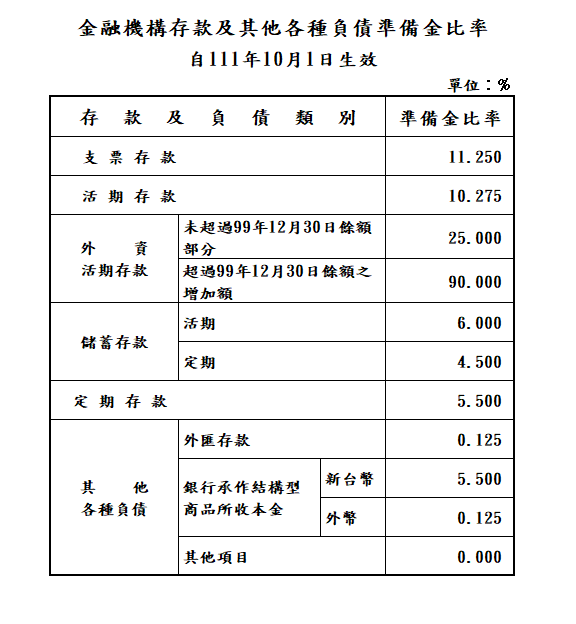
The Bank shall receive and keep reserves against deposits and other liabilities of banks which are regulated by Banking Law of the Republic of China, and may, at its discretion, adjust various deposit and other liability reserve ratios under the following maximum limits in accordance with the regulation governing adjustment and audit thereof, which shall be prescribed by the Bank:

1.Checking deposits: 25%

2.Demand deposits: 25%

3.Savings deposits: 15%

4.Time deposits: 15%

5.Other liabilities: 25%

The scope of aforesaid other liabilities shall be prescribed by the Bank.

The Bank may, whenever necessary and from a specific date, impose on the increment of the checking deposits, demand deposits and other liabilities, a marginal reserve ratio which shall not be bound by the maximum limits on section 1 of this Article.

The Bank may charge the banks having deficient reserves, on the portion of the deficiency, a penalty interest rate not higher than two times of that prescribed in accord with Article 21, on unsecured temporary advances as stated in item 2, Section 1 of Article 19.


* Article 24:

The Bank shall, in conformity with law, receive and keep reserves for indemnity deposited by investment and trust companies.


* Article 25:

The Bank, after consulting with the Ministry of Finance, may at its discretion, prescribe for banks a minimum ratio of their liquid assets to their various liabilities.


* Article 26:

The Bank may, in the light of financial conditions, purchase and sell in the open market the bonds issued or guaranteed by the government, financial bonds issued by banks and bills accepted or guaranteed by banks.


* Article 27:

The Bank may, for the purpose of monetary regulation, issue certificates of time deposits, savings bonds and short-term bonds, and may purchase and sell them in the open market.


* Article 28:

The Bank may, whenever necessary, prescribe maximum loanable ratios, selectively, on the items used as collateral or mortgage of secured loans extended by banks.


* Article 29:

The Bank may, whenever necessary, prescribe and regulate the amount of down-payment and the term of credit extended by banks for the purchase or construction of buildings and the purchase of durable consumer goods.


* Article 30:

The Bank shall prescribe and regulate the accommodations extended by banks to securities dealers and securities finance companies.


* Article 31:

The Bank may, whenever it deems that the monetary and credit conditions so warrant, prescribe a maximum limit for the amount of various kinds of credit extended by all, or any category of, financial institutions.


* Article 32:

The Bank shall establish a clearing house for checks and settlement of accounts among banks at the sites of Head Office or branch offices. The Bank may delegate a government bank to carry out this function in places where the Bank has no branch office. Regulations governing checks clearance and settlement of accounts among banks shall be stipulated by the Bank.


* Article 33:

The Bank shall hold the international monetary reserves, and undertake the over-all management of foreign exchange.


* Article 34:

The Bank may, in the light of balance of payments situation, take measures to adjust the demand for, and supply of, foreign exchange with the view of maintaining an orderly foreign exchange market.


* Article 35:

The Bank shall undertake the following foreign exchange operations:

1.To draw up plans for foreign exchange management and on anticipated receipts and payments;

2.To authorize and supervise banks and other enterprises engaging in foreign exchange operations;

3.To settle the purchase and sale of foreign exchange;

4.To examine and approve private outward and inward remittances;

5.To supervise private enterprises' foreign borrowings guaranteed by appointed banks, with reference to their management and their repayment on schedule;

6.To purchase and sell foreign currencies, bills of exchange and securities;

7.To calculate, compile, analyse and report the receipts and payments of foreign exchange;

8. Other operations relating to foreign exchange.

Regulations governing requirements of application, the examination procedure, approval of appointment, the scope of foreign operations, withdrawal of appointment, and other matters which banks and other enterprises applying to engage in foreign exchange operations must comply with, shall be stipulated by the Bank.


* Article 36:

The Bank shall effect the operations of the National Treasury and manage the National Treasury's cash accounts. It shall also manage the Central Governmental agencies' cash accounts, bills, securities, including receipts and payments, safekeeping and transfers, and the safekeeping of their other asset documents.

The Bank may delegate, whenever necessary, the operations mentioned above to other financial institutions in places where the Bank has no branch office.


* Article 37:

The Bank shall undertake the floatation and the redemption of government bonds, issued domestically or abroad, and treasury bills. The Bank may delegate, whenever necessary, the above to other financial institutions.


* Article 38:

In conformity with the powers and functions authorized in this Act, the Bank shall undertake the examination of the operations of all financial institutions in the country.

The above examination may be performed in coordination with the bank examination program delegated to the Bank by the Ministry of Finance.

The Bank may delegate a government financial institution to perform the examination of the operations of the credit cooperatives and the credit departments of farmers' associations.


* Article 39:

To coordinate the formulation of monetary policies and the exercising of financial operations, the Bank shall, regularly, undertake to collect economic information, compile financial statistics and conduct monetary and economic research.

*
Chapter IV. Budgets and Fiscal Reports

* Article 40:

Before the beginning of each fiscal year, the Bank shall prepare a draft budget for examination and adoption by the Board of Directors, the adopted budget shall be processed in accordance with the Budgeting Law.


* Article 41:

After the close of each fiscal year, the Bank shall prepare fiscal reports for examination and adoption by the Board of Directors. The adopted reports shall be examined and approved by the Board of Supervisors, and processed in accordance with the Fiscal Reporting Law.


* Article 42:

At the close of each fiscal year, the Bank shall set aside fifty per cent of its net profit as legal retained earnings. In case the amount of the accumulated legal retained earnings reaches that of the Bank's current capital, the percentage herein prescribed may, subject to the resolution of the Board of Directors and the concurrence of the Board of Supervisors, be reduced to not lower than twenty per cent.


* Article 43:

The gain or loss from the Bank's assets or liabilities denominated in gold, silver, foreign currencies and other forms of international reserve, due to changes in parity of the national currency, or changes in the value, parity or exchange rate of these assets and liabilities relative to the national currency, shall not be listed as the Bank's annual profit or loss.

Any gain from the above changes shall be entered into an Exchange Reserve Account, and any loss shall be offset in the balance of that Account.

*
Chapter V. Appendix

* Article 44:

This Act shall become effective on the date of promulgation.

The effective date of Article 23 amendment shall be prescribed by the Executive Yuan.


﹝Remarks:This Act is made in Chinese which shall prevail in case of any discrepancy between the English translation and the Chinese original.﹞


back


:::updated:2007/2/12
Best viewed with IE 5.0 or higher with 800×600 resolution/Privacy/Security/FAQ
Copyright @2004 the Central Bank of the Republic of China
Add./ Map : 2, Sec. 1, Roosevelt Rd., Taipei, 10066, Taiwan, R.O.C. / Office Hours
Tel: 886-2-2393-6161 Fax: 886-2-2357-1971